I believe Jesus rose from the dead and is alive today. But a claim this significant deserves more than being told to have faith.
This page lets you follow the sources behind our conversation, check what they actually say, and investigate further.
Some are ancient writings. Some are physical discoveries. Others are modern books and films that help explain the arguments. They contribute different things, and we need to be clear about those differences.
Check the sources · Watch and explore · Read further
Check the sources
How do we assess something that happened so long ago?
We cannot rerun an ancient event. We can examine the records, ask how close their writers were to what happened, compare accounts, and consider which explanation best fits the evidence.
That is what I mean by weighing the balance of probabilities: looking for enough evidence to draw an informed conclusion. It is not a claim that every historian uses the same formula, or that ancient history is simply a courtroom with a different name.
UCLA’s historical thinking guidance describes assessing evidence, comparing competing explanations, and recognising uncertainty. It provides a useful starting point for understanding the approach.
Read UCLA’s Historical Analysis and Interpretation guidance
How early was the resurrection being proclaimed?
Paul’s first letter to the Corinthians, chapter 15 — written in the AD 50s
Paul reminds his readers of the message he had already passed on: Jesus died, was buried, was raised, and appeared to witnesses. Paul says he had received this message himself.
That distinction matters. The letter records an existing proclamation; it is not presented as a new idea Paul has just developed.
The passage names Peter, James and others, and includes Paul’s own claim to have seen Jesus. It also reports an appearance to more than 500 people. We have Paul’s report of that group, rather than 500 surviving individual statements.
The proclamation therefore predates this letter. Pinning its original wording to one exact year requires further argument; the date of the letter alone cannot do that.
Read 1 Corinthians 15:1–11 · Check the letter’s approximate date
Paul’s letter to the Galatians, chapter 1
Paul describes visiting Peter for fifteen days and meeting James, Jesus’ brother. This places him in direct contact with people who were central to what happened.
Paul does not give us a transcript of those conversations. The passage establishes contact; we should not invent what they discussed.
What does the P46 manuscript show us?
Papyrus 46, usually shortened to P46 — commonly dated around AD 200
P46 is an early surviving collection of Paul’s letters. Its surviving pages include the resurrection passage in 1 Corinthians 15.
The Chester Beatty catalogue identifies a leaf containing 1 Corinthians 14:34–15:15, including the beginning of Paul’s account of the message he received and the reported appearances.
There are three dates to keep separate: when Paul received the message, when he wrote the letter, and when this surviving copy was made.
P46 is evidence for the early transmission of the letter. It was not written by Paul himself, and its approximate date does not date the resurrection tradition to AD 200. The University of Michigan explains why handwriting is used to estimate its age and why estimates vary.
Explore P46 with the University of Michigan · View the Chester Beatty catalogue leaf
Why does it matter that women were the first witnesses?
All four Gospels place women at the discovery of the empty tomb. Matthew describes Jesus meeting the women; John describes his appearance to Mary Magdalene. Luke records the apostles initially rejecting the women’s report.
The accounts differ in detail. We should read each one on its own terms rather than combine them into an account none of the writers actually gave.
Josephus, Antiquities of the Jews 4.8.15 (4.219)
In his presentation of Jewish legal rules, Josephus explicitly excludes women’s testimony. This documents a prejudice the Gospel accounts would encounter. It is not evidence that women could never testify in any court or circumstance throughout the ancient world.
Read Josephus’s account — chapter 8, paragraph 15
Origen, Against Celsus 2.55 and 2.59
Origen preserves and answers Celsus’s attack on the resurrection accounts. Celsus ridicules a female witness as a “half-frantic woman.” We encounter his words through Origen’s quotation and response, rather than through a surviving complete copy of Celsus’s work.
This shows that the female witness could become a target for criticism.
Read the exchange — chapters 55 and 59
What follows from this?
If the story were invented simply to win credibility among people holding those prejudices, women would be an unexpected choice for its first witnesses.
That supports taking their central role seriously as a remembered feature of what happened. It does not make invention impossible: a writer might also have narrative or theological reasons to include them. I find it persuasive as part of the evidence taken together.
Matthew 28:1–10 · Mark 16:1–8 · Luke 24:1–12 · John 20:1–18
What do we actually know about the witnesses’ commitment?
We should take their suffering seriously without attaching unreliable stories to every disciple.
These are some of the sources we can check:
| Source | What it records |
|---|---|
| Acts 5:17–42 | The apostles’ imprisonment, flogging and continued public teaching. |
| Acts 12:1–5 | The execution of James, John’s brother, and Peter’s imprisonment. |
| 2 Corinthians 11:23–29 | Paul’s own account of imprisonment, repeated beatings and other hardships. |
| 1 Clement, chapter 5 | An early Christian account of Peter and Paul’s suffering and deaths. |
1 Clement, a letter from the church at Rome to the church at Corinth, is commonly dated around AD 95. It is an important early source beyond the New Testament. It does not supply every detail later associated with Peter and Paul’s executions.
The evidence is stronger for some individuals than others. We cannot responsibly give all eleven remaining disciples the same documented life story, or claim that every one was offered freedom if he would deny the resurrection.
People can suffer for something they believe to be true but isn’t. The relevant distinction here is that these men were presented as witnesses to Jesus’ life, death and resurrection. Knowingly maintaining their own lie through imprisonment and violence would need a convincing explanation.
Their commitment supports the case that they believed their testimony. Deciding whether they were right also requires examining what they reported.
N. T. Wright — willingness to suffer and die
In an interview with Crossroads, historian and New Testament scholar N. T. Wright describes it as highly unlikely that the disciples would have gone to their deaths for a claim they knew was false. He also acknowledges that the circumstances of every apostle’s death are not known, and treats this as one part of the cumulative argument.
Read Wright’s interview — “Dying for a Lie?”
Lee Strobel — why the witnesses’ commitment matters
In his message The Case for the Resurrection, Strobel recounts his investigation and conversion from atheism to Christianity. He includes the disciples’ willingness to suffer for their proclamation among the evidence he presents.
His point is that they were claiming firsthand encounters with Jesus alive after his death. Their willingness to suffer therefore bears on whether they were knowingly inventing those encounters, rather than simply repeating a belief they had been taught.
Read or watch Strobel’s message at Cherry Hills Community Church
What about money or personal benefit?
Paul says he declined financial support from the Corinthians, while also acknowledging support from other churches. That is different from claiming the early Christians never received support.
Read 1 Corinthians 9:1–18 · Read 2 Corinthians 11:7–9
What changed Paul?
Paul’s own letter describes his earlier persecution of the church. Acts describes the fear that remained when he tried to join the disciples in Jerusalem: they did not believe he had become a disciple until Barnabas spoke for him.
What changed him from persecuting Christians to being willing to endure imprisonment and violence for proclaiming the same faith?
Paul’s answer was that Jesus had appeared to him. His transformation is part of the historical case we need to explain, alongside his own account of that encounter.
Read Galatians 1:13–24 · Read Acts 9:26–28 · Read 1 Corinthians 15:8–11
What can archaeology confirm?
The Pilate inscription — discovered at Caesarea in 1961
This inscription names Pontius Pilate and identifies his office as prefect of Judea. It provides physical evidence for the Roman governor named in the accounts of Jesus’ death.
It confirms part of the historical setting. It does not establish what happened at Jesus’ tomb.
View the Israel Museum’s inscription record · Find “Pontius Pilate and the Caesarea Inscription” at Andrews University
The Megiddo Mosaic — discovered in 2005; dated by Museum of the Bible to around AD 230
An inscription in this early Christian worship space records a donated table and refers to “God Jesus Christ.”
That gives us a tangible example of a community honouring Jesus as divine well before Constantine’s rule in the AD 300s. It challenges the idea that this belief began with Constantine or the church councils from AD 300 onwards, including Nicaea in AD 325.
The mosaic records the community’s belief and worship. The resurrection itself must be assessed through the wider evidence.
In September 2026, I saw the Megiddo Mosaic at Museum of the Bible in Washington DC and took my own photographs of it.
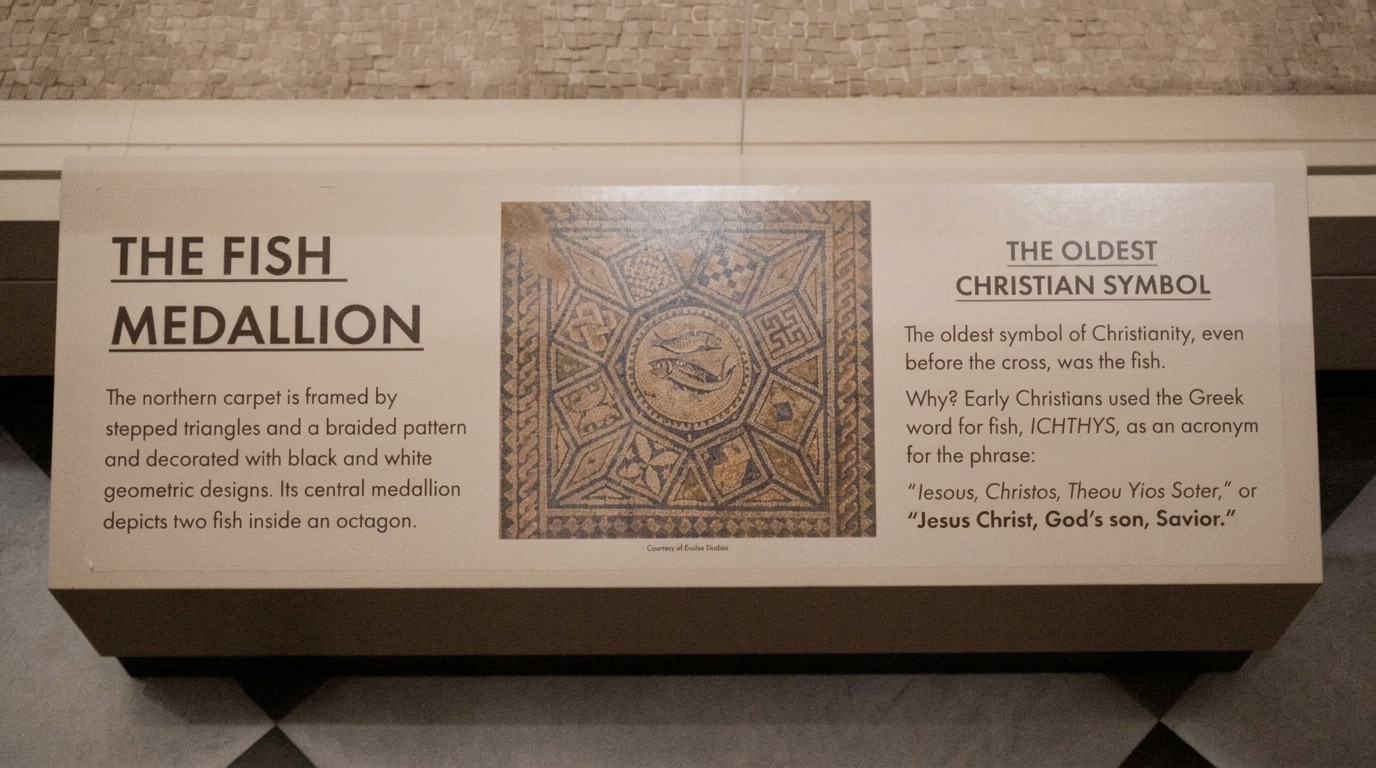
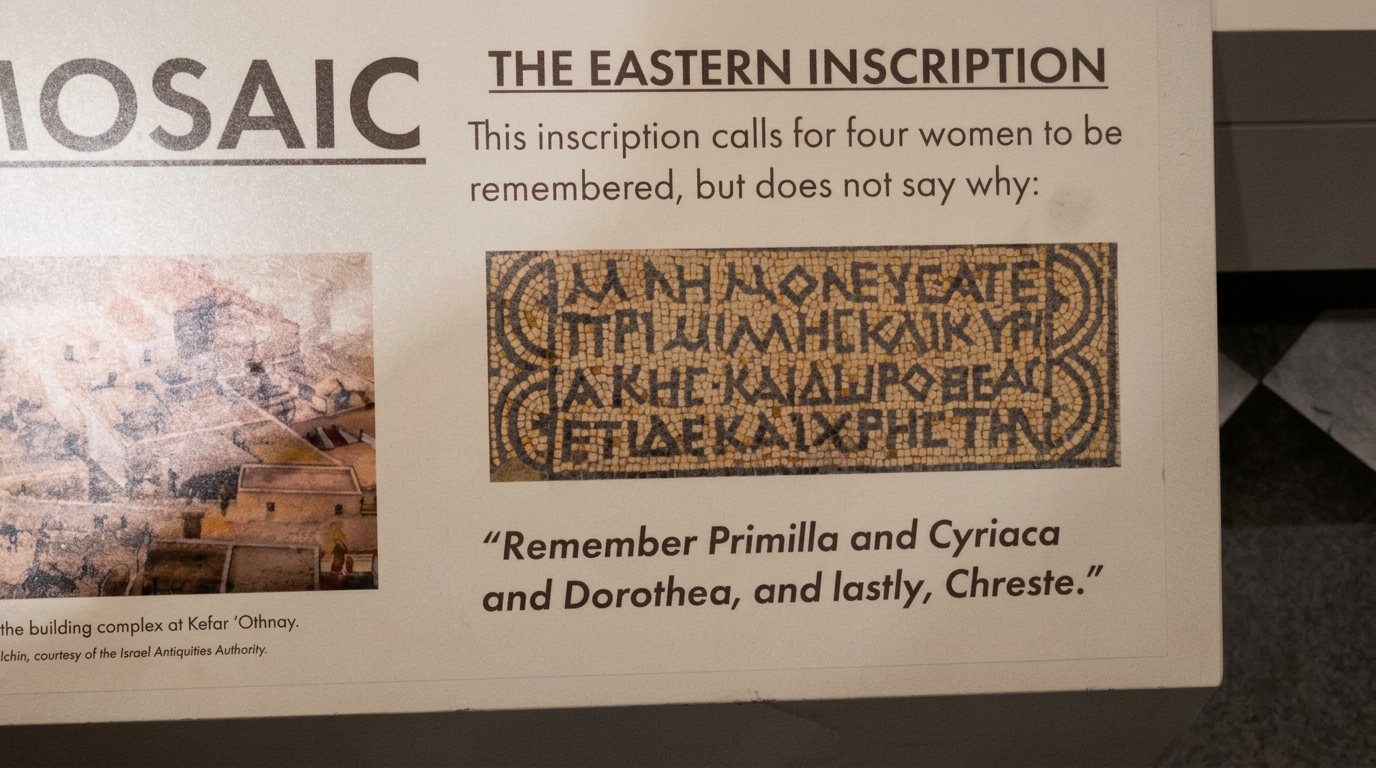
Explore the mosaic with Museum of the Bible
What can an ancient hymn tell us?
Papyrus Oxyrhynchus 1786, also catalogued as P.Oxy. XV 1786 — late AD 200s
This fragment preserves part of a Christian hymn with both words and musical notation. It offers another window into early Christian worship.
It is not the first Christian hymn ever written. Its particular importance is the survival of both the words and their music.
For detailed research, Charles H. Cosgrove’s An Ancient Christian Hymn with Musical Notation: Papyrus Oxyrhynchus 1786: Text and Commentary was published by Mohr Siebeck in 2011.
View the Oxford catalogue entry · See Cosgrove’s study
Did the church councils turn Jesus into God?
The Council of Nicaea met in AD 325. Its creed describes the Son as sharing the Father’s divine nature, and its letter addresses the dispute over Arius’s teaching about the Son.
The council made a formal doctrinal judgement about Jesus’ relationship to the Father. That is different from beginning the practice of worshipping Jesus as divine. The earlier Megiddo inscription documents such worship before Nicaea.
This does not mean every Christian had already agreed on the precise language later used by the councils. It means the claim that the councils invented Jesus’ divinity does not fit the earlier evidence.
Read the Nicene Creed of AD 325 and the council’s letter
For the biblical evidence behind the belief that Jesus is God, see Why Jesus? and its Biblical Foundations.
Where can I examine the alternative explanations?
A stolen body, survival or deception
Mark records Jesus’ burial, Pilate checking his death with the centurion, and the women’s discovery of the empty tomb. Luke describes reported encounters involving conversation, wounds and eating.
These are the accounts an alternative explanation needs to address. Reading them does not require assuming their conclusion in advance; it lets us test an explanation against what the sources actually claim.
Moving a body would not, by itself, explain the reported encounters. Survival would require an explanation of how Jesus survived and recovered. A deliberate deception would also need a plausible organiser, method and motive, supported by evidence.
Read Mark 15:42–16:8 · Read Luke 24:36–43
A specific survival theory: Barbara Thiering
Thiering’s Jesus the Man was published by Doubleday in 1992. Her own 2005 online narrative, “Complete Pesher of the Resurrection: Part B: The Combined Narrative,” describes a theory involving drugging or poisoning, removal from the cross while alive, and assistance from others.
It does not describe Jesus simply waking up, beating the guards and escaping unaided.
The underlying question is whether her proposed hidden-code reading of the texts is justified. Géza Vermes challenged that method in a 1994 exchange. Eben Scheffler’s 2016 article also rejects the arbitrary code-reading approach.
The 1994 critique predates the 2005 narrative. These sources should be described as critiques of her method, rather than presented as one later, line-by-line refutation of that particular narrative.
Read Thiering’s 2005 narrative · Read the 1994 Thiering–Vermes exchange · Read Scheffler’s 2016 discussion
Could grief explain the appearances?
People sometimes report seeing, hearing or sensing someone who has died. We should acknowledge that rather than dismiss those experiences.
Evelyn Elsaesser and colleagues’ 2021 study, “The phenomenology and impact of hallucinations concerning the deceased,” examines such experiences. It does not investigate Jesus’ resurrection.
It provides context for considering an alternative explanation. We still need to ask whether that explanation adequately accounts for the particular reports, including Paul’s, and how confidently we can establish their details.
Watch and explore
The Case for Christ — feature film, 2017
A drama about Lee Strobel’s investigation of Christianity after his wife becomes a Christian.
This is an accessible way into the questions and their personal significance. It is a dramatised story; use the historical sources alongside it when examining individual claims.
Explore the film and official viewing options
The Case for Easter — four-session video study with Lee Strobel
A focused investigation of Jesus’ death, the empty tomb and the reported appearances.
The publisher’s The Case for Easter Bible Study Guide + Streaming Video, Updated Edition: Evidence for the Resurrection of Jesus is credited to Lee Strobel and Bill Butterworth.
This is the video study recommended here. The updated guide-and-streaming package should not be confused with a newly produced documentary.
Explore the study and streaming package
The First Hymn — documentary, 2025
Hosted by historian John Dickson, this documentary follows the ancient hymn fragment discussed above. Chris Tomlin and Ben Fielding develop a modern musical adaptation.
The ancient manuscript, the documentary and the modern song are three distinct things. The film helps bring the manuscript’s story and the worship of early Christians to life.
Watch the trailer and explore official viewing options
Read further
Sean McDowell The Fate of the Apostles: Examining the Martyrdom Accounts of the Closest Followers of Jesus — second edition, Routledge
A more detailed investigation of the historical evidence concerning the apostles’ deaths. This is a useful next step if you want to distinguish early evidence from later traditions.
John Lennox Can Science Explain Everything? — The Good Book Company, 2019
An accessible starting point for questions about science, faith, miracles and the reliability of the Christian account. Its contents include discussions of miracles and testing Christianity’s claims.
Explore the book and read a sample
John Lennox Gunning for God: Why the New Atheists Are Missing the Target
A broader examination of objections to belief in God. Useful for readers whose questions about the resurrection connect with larger questions about whether belief in God is reasonable.
Find the book through John Lennox’s official book collection
I find the evidence taken together convincing. That is why I believe the resurrection deserves serious consideration as something that actually happened.
My relationship with Jesus is personal. These historical sources are available for you to examine for yourself.